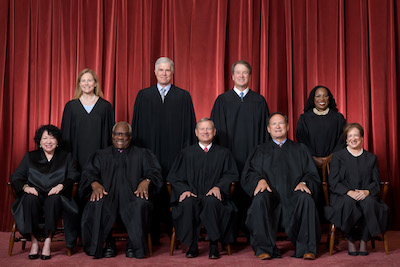
The Supreme Court opens its new term on Monday, October 5, and the very first case it will hear could decide whether local governments can drag the energy industry into court over the weather.
The case is Suncor Energy v. Commissioners of Boulder County. It is the opening act of a term that also includes big fights over gun bans, religious liberty and proof of citizenship to vote.
What Boulder wants
Boulder County and the City of Boulder filed suit in April 2018 against ExxonMobil and Suncor Energy, a Canadian oil company, according to Boulder County. The local governments want the companies to help pay for costs they blame on climate change, including drought, wildfires, floods and extreme heat.
Boulder claims the companies “knowingly concealed” the dangers of their products, according to CU Boulder Today. Chris Winter, an environmental attorney at CU Boulder’s Getches-Wilkinson Center, put it plainly: Boulder “wants the oil industry” to share in those costs.
The case has gone Boulder’s way so far. In May 2025, the Colorado Supreme Court ruled that federal law did not block the county’s claims and that they could go forward under state law.
The question for the justices
The Supreme Court agreed to take the case on February 23, 2026, according to SCOTUSblog. The core question is whether federal law bars state-law claims for injuries blamed on emissions that cross state and national borders and affect the global climate. The justices also asked both sides to address whether the Court has jurisdiction to hear the case at all.
This is not a one-city matter. CU Boulder Today reports roughly three dozen similar lawsuits have been filed by state, local and tribal governments around the country. None has reached trial. A ruling is expected by summer 2027.
The Trump administration weighs in
The Justice Department is siding with the energy companies. It filed a brief without being invited by the Court and won its own time at oral argument, according to Rocky Mountain Voice.
Deputy Solicitor General Sarah Harris framed the case this way: “Can one city wield one State’s law to dictate how the rest of the world must address a global problem with global effects?” The brief’s answer: “Absolutely not.”
The department argues that one city cannot use state law to regulate energy production across the nation and the world, and that doing so runs against the Constitution’s structure and the Clean Air Act.
Commentary: regulation by lawsuit
Strip away the legal language and here is what this case is about. Voters and Congress have repeatedly declined to adopt the sweeping climate policies activists want. So activists found another route: sue the companies that produce the fuel everyone uses, in a friendly local court, under state nuisance law.
If that works, a jury in one county could effectively set energy policy for every American. Legal commentator Jonathan Turley warned that a win for Boulder could “expose companies to potentially thousands of climate change lawsuits.” Those costs would not stay with the oil companies. They would show up at the gas pump, on the heating bill and in the price of everything shipped by truck.
The self-reliant family in rural Colorado did not cause the climate to change by driving to work. Neither did the trucker or the farmer. But under Boulder’s theory, they would end up paying for the settlement.
Energy policy for a nation belongs with elected officials who answer to voters, not with a patchwork of county courthouses. That is the federalism point at the heart of this case, and it is a strong one.
The rest of the term
Boulder is just the start. According to the National Constitution Center, the Court has also agreed to hear:
- RNC v. Mi Familia Vota: Whether Arizona can require proof of citizenship to register to vote and audit voter rolls within 90 days of a federal election.
- Viramontes v. Cook County and Grant v. Higgins: Challenges to assault-weapons bans, testing whether rifles like the AR-15 are protected by the Second Amendment.
- St. Mary Catholic Parish v. Roy: Whether Colorado can deny preschool funding to Catholic parishes that refuse to sign its nondiscrimination pledge on sexual orientation and gender identity.
- Grand v. City of University Heights: A homeowner’s fight over city orders that stopped private prayer gatherings at his home.
None of those cases is on the October argument calendar, so expect them later in the term. Turley notes the Court takes only 70 to 80 cases a year out of thousands of requests.
For conservatives, this could be a landmark term for the Second Amendment, religious freedom and election integrity. It starts with a simple question on October 5: who gets to set America’s energy policy?
Sources
- U.S. Supreme Court to Hear Boulder Climate Case Monday (Boulder County)
- A landmark Boulder climate case is heading to SCOTUS. What’s at stake? (CU Boulder Today)
- Suncor Energy Inc. v. County Commissioners of Boulder County (SCOTUSblog)
- Justice Department warns Boulder can’t set global energy policy (Rocky Mountain Voice)
- The October Term: A Preview of the Coming Cases (Jonathan Turley)
- Four cases to watch in the Supreme Court’s next term (National Constitution Center)
- October 2026 argument calendar (Supreme Court)